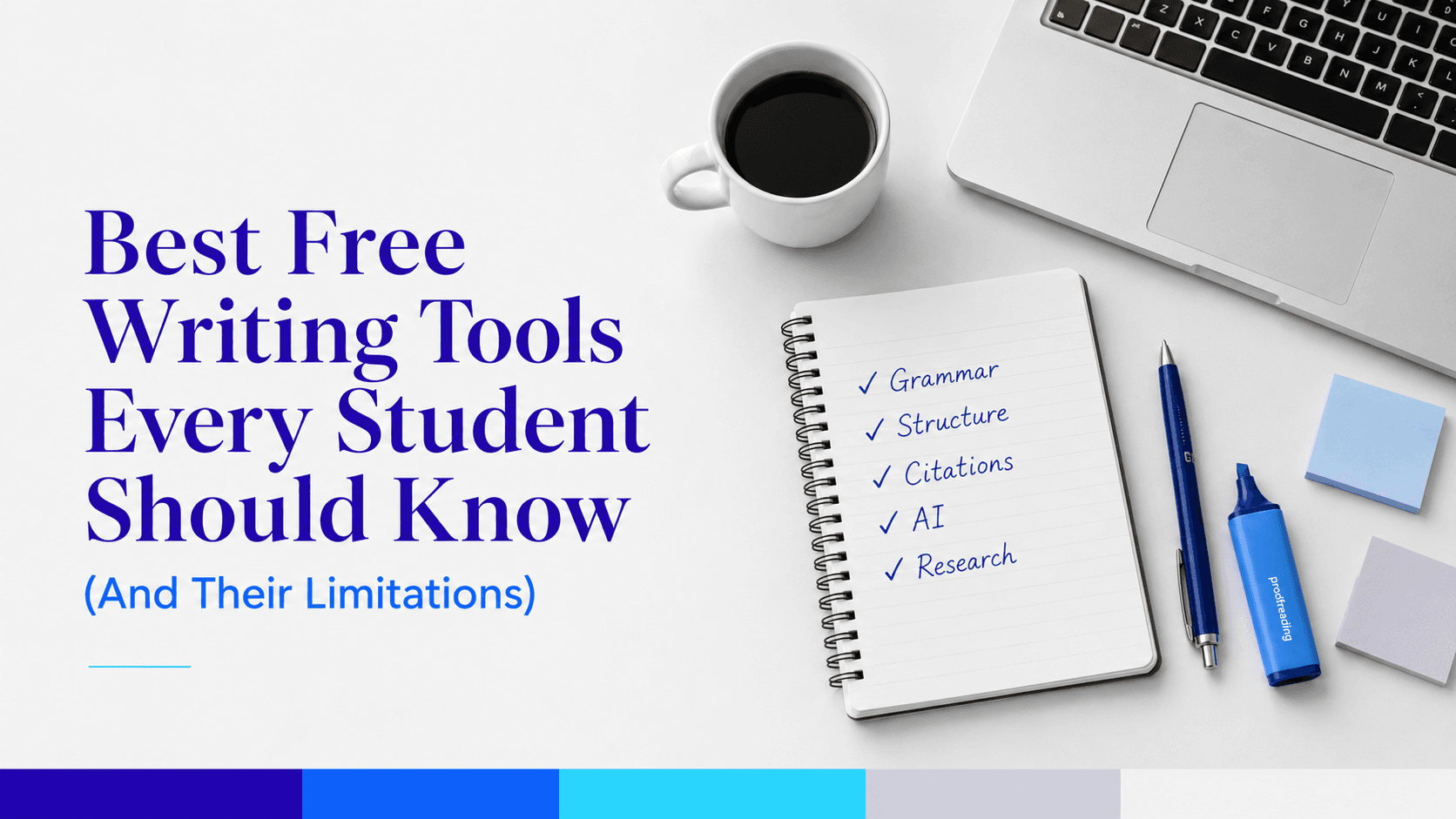
Best Free Writing Tools Every Student Should Know (And Their Limitations)
Best Free Writing Tools Every Student Should Know (And Their Limitations)
Free writing tools can help you write faster.
They can't always help you write better.
From grammar checkers to AI assistants and citation managers, today's students have access to dozens of free tools that simplify the writing process.
Knowing what each tool does well, and where it falls short, can help you produce stronger academic work.
Best Free Writing Tools, and Where They Fall Short
Google Docs gives students a reliable place to draft, comment, and collaborate with classmates. Real-time commenting and version history make it particularly valuable for group projects. However, formatting may shift when you export files, there is only basic grammar assistance, and collaborative editing can introduce inconsistencies if multiple contributors make changes without clear coordination.
Write & Improve by Cambridge is another strong choice, especially for students writing in English (and even more for those whose first language is not English). It gives instant feedback and helps learners practice and improve over time, though it is more focused on language practice than on building strong arguments or organizing long essays.
Grammarly catches many spelling, punctuation, and grammar errors while you write. For many students, it serves as an excellent first step in proofreading. However, the free version provides only basic corrections. It may overlook more complex issues such as logical flow, discipline-specific language, or subtle tone differences. In some cases, its recommendations may even change the intended meaning of a sentence.
QuillBot Free, known for its paraphrasing capabilities, can help you rewrite repetitive sentences or explore alternative wording when you struggle to express an idea. Although it is useful for overcoming writer’s block, the free version has several limitations. More importantly, paraphrased text should always be reviewed carefully, as automated rewrites can introduce awkward phrasing, factual inaccuracies, or unintended shifts in meaning.
ChatGPT can help you brainstorm questions, test an outline, or identify unclear wording. It can also produce incorrect details, invented citations, or generic prose. Your instructor’s AI policy matters, too, so it is best to use it sparingly and only when permitted.
Zotero organizes research and inserts references in major citation styles. The free Zotero research assistant is especially useful once your source list grows. Nevertheless, imported records can contain missing authors, dates, or capitalization errors. Compare its output with a guide to citation-management tools, then have an editor verify key citations.
Quick Comparison

While these free tools offer valuable support, they are best viewed as assistants rather than authors or editors. They excel at identifying mechanical issues, improving organization, and speeding up routine tasks, but they cannot fully evaluate the quality of arguments, evidence, or coherence, or whether a paper successfully addresses an assignment’s objectives. They may also suggest changes that sound technically correct but do not fit the student’s intended tone or meaning.
This is where professional human editing adds something software cannot: judgment. A human editor can tell whether an argument is convincing, whether a paragraph actually supports the thesis, and whether the writing sounds natural for the assignment and audience. Human editing is especially valuable for final drafts, scholarship applications, research papers, and any piece where clarity and credibility matter most. Tools can polish sentences, but a skilled editor can improve the logic, flow, voice, and overall impact of the work.
Ready to Take Your Writing Further?
Free writing tools are great for brainstorming, drafting, and catching basic mistakes—but they can't replace human judgment.
Our professional editors help students improve clarity, structure, grammar, and overall readability before submission.