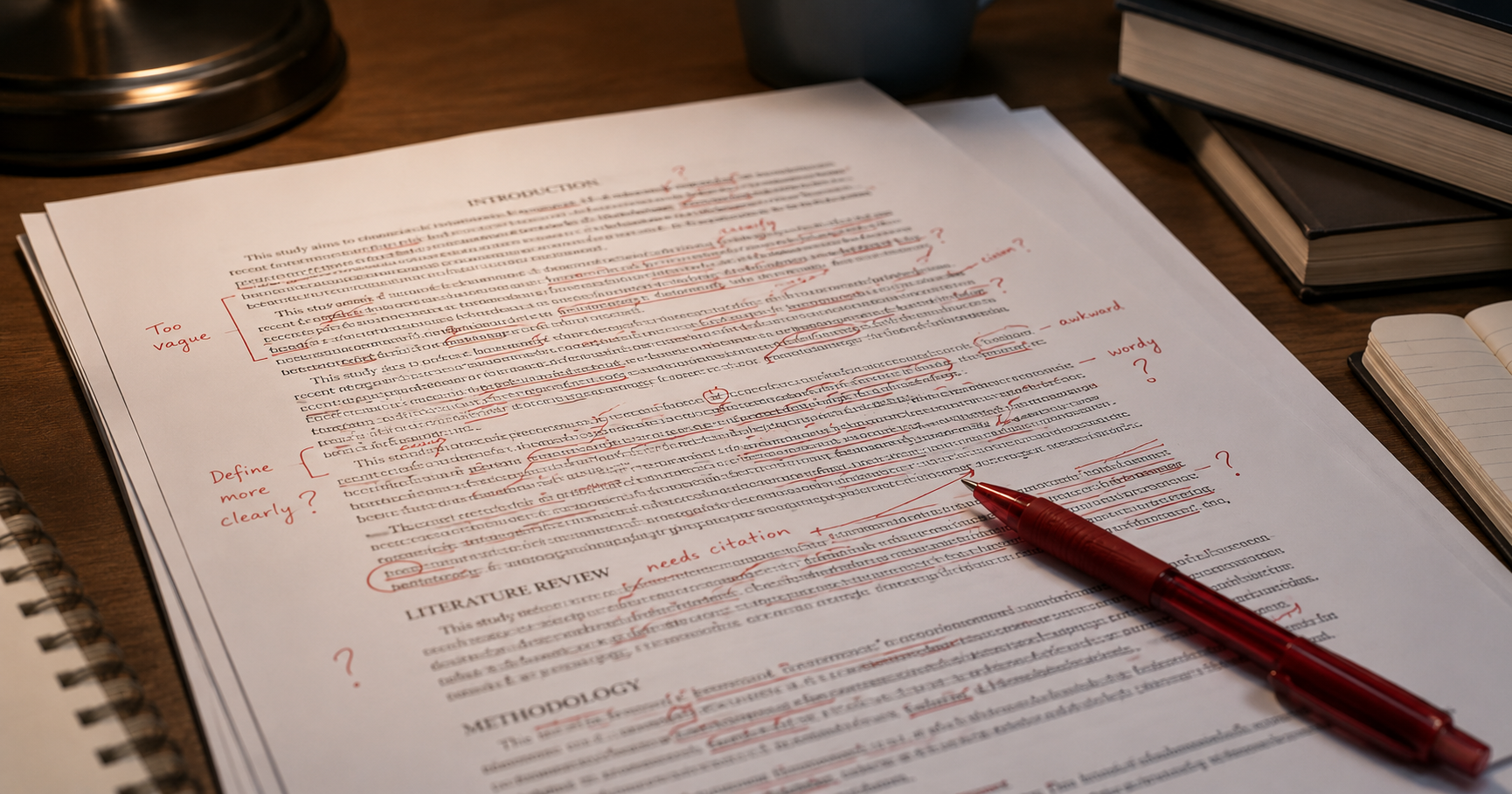

How Long Does Academic Editing Take? Turnaround Times Explained
If you have ever sent a paper off for editing, you have probably wondered: How long is this going to take? The answer isn’t as simple as a fixed number of hours or days. Two papers with the same word count can take completely different amounts of time to edit. Why? Because editing is not just about reading; it’s about analyzing, correcting, and refining the text at multiple levels. Understanding what affects turnaround time can help you plan ahead and set realistic expectations.
Get an instant editing quote — delivery from 2 hours
So, let’s analyze some of the factors that influence turnaround time.
1. Topic Complexity and Use of Jargon
Some subjects are simply harder to edit than others. Papers in highly specialized fields often include dense terminology, discipline-specific jargon, and complex sentence structures. When a text is heavy with technical language, the editor has to slow down to ensure terminology is used correctly, sentences remain clear despite the complexity, and the meaning is preserved while improving readability.
Even if the editor is familiar with the field, technical writing demands careful attention. If they’re less familiar, they may need to verify terminology or context, which adds time. In contrast, a paper written on a more general topic or in an accessible language can usually be edited more quickly.
2. The Number of Corrections Needed
This is one of the most significant factors affecting turnaround time. A text that is already fairly polished—clear structure, correct grammar, appropriate vocabulary—can be edited relatively efficiently. In many cases, this kind of document takes about 1 hour per 1,000 words.
However, if the paper has frequent grammatical and punctuation errors, awkward or unclear phrasing, repetitive or incorrect word choices, and/or inconsistent terminology, then the editing process becomes much more time-intensive. For heavily flawed texts, editing can take twice as long or more. That’s because the editor isn’t just refining the writing; they’re actively reconstructing it to make it readable and coherent.
3. Structure and Clarity
In the same vein, overall organization plays a major role. A well-structured paper with a clear introduction, logical flow, and cohesive paragraphs is much easier to edit, as the editor can focus on improving clarity and language. However, if the text lacks a clear argument, jumps between ideas without transitions, uses paragraphs inconsistently, or fails to support claims effectively, the editor may need to spend additional time reorganizing or suggesting structural changes.
Naturally, that increases turnaround time.
4. Compliance with Style Guides
Academic writing often requires strict adherence to a specific style guide—APA, MLA, Chicago, or others, depending on the field.
Ensuring compliance isn’t just about formatting headings or citations. It includes in-text citation accuracy, reference list formatting, consistency in punctuation, capitalization, and abbreviations, proper use of numbers, dates, and terminology, among others.
In addition, if a paper includes references, the editor may need to cross-check each one against the style guide. If citations are inconsistent or incomplete, this process can take a significant amount of time.
A paper that already follows the required style closely will move through editing much faster than one that needs extensive corrections.
Our editors handle APA, MLA, Chicago, and 6 other citation styles. Get a quote →
5. Matching Tone and Academic Voice
Another key part of academic editing is ensuring the tone fits the intended purpose.
Academic writing should generally be clear, precise, objective, formal, and free of overly casual or conversational language. When a paper includes informal phrasing, vague wording, or an inconsistent tone, the editor has to adjust it throughout the text. This process isn’t always a quick fix, as rewriting for tone requires careful judgment to maintain the author’s meaning while improving suitability.
The more adjustments needed, the longer the editing process will take.
6. The Editor’s Speed and Workload
Not all editors work at the same pace—and that’s not necessarily a bad thing.
Some editors work at a faster reading pace than others. Because of this, you can’t apply a single timeline to every editor. One person might complete a task in a few hours, whereas another might take longer.
Additionally, editors rarely work on just one paper at a time. Most are managing multiple projects with overlapping deadlines. This means turnaround time isn’t only about how long your paper takes to edit—it’s also about where it fits in the editor’s schedule.
If you request a short turnaround, the editor may need to reschedule other work, work under tighter time constraints, or prioritize speed over deeper revisions, which can affect the turnaround time not only for your paper but also for others.
So, how long should you expect?
Although there’s no fixed rule, a general guideline looks like this:
Well-written text: ~1 hour per 1,000 words
Moderately flawed text: ~1.5 hours per 1,000 words
Heavily flawed or unclear text: ~2+ hours per 1,000 words
These are rough estimates, not guarantees. The actual time will depend on all the factors discussed above.
Final Thoughts: Give Your Editor Time to Do It Right
If you want the best possible outcome, timing matters.
When submitting a paper for editing:
Allow more time than you think you’ll need
Avoid setting urgent deadlines unless absolutely necessary
Be realistic about the condition of your text
Good editing takes focus and attention. Rushing the process can limit the amount of improvement possible.
It’s also worth remembering that editors are often juggling multiple projects. Giving them enough time doesn’t just make their job easier—it directly benefits your work.
Ready to submit? Get a free editing quote — human editors, turnaround from 2 hours