How to End Your Essay with a Strong Conclusion
How to End Your Essay with a Strong Conclusion
Your conclusion is the last thing your professor will read.
Yet it's often the first part students rush to finish.
A strong conclusion doesn't just end your essay.
It reinforces your argument and leaves readers with a clear understanding of why your ideas matter.
A conclusion is more than a stopping point, it is your final chance to reinforce your argument and leave readers with a clear understanding of why your ideas matter.
What a Strong Conclusion Should Do
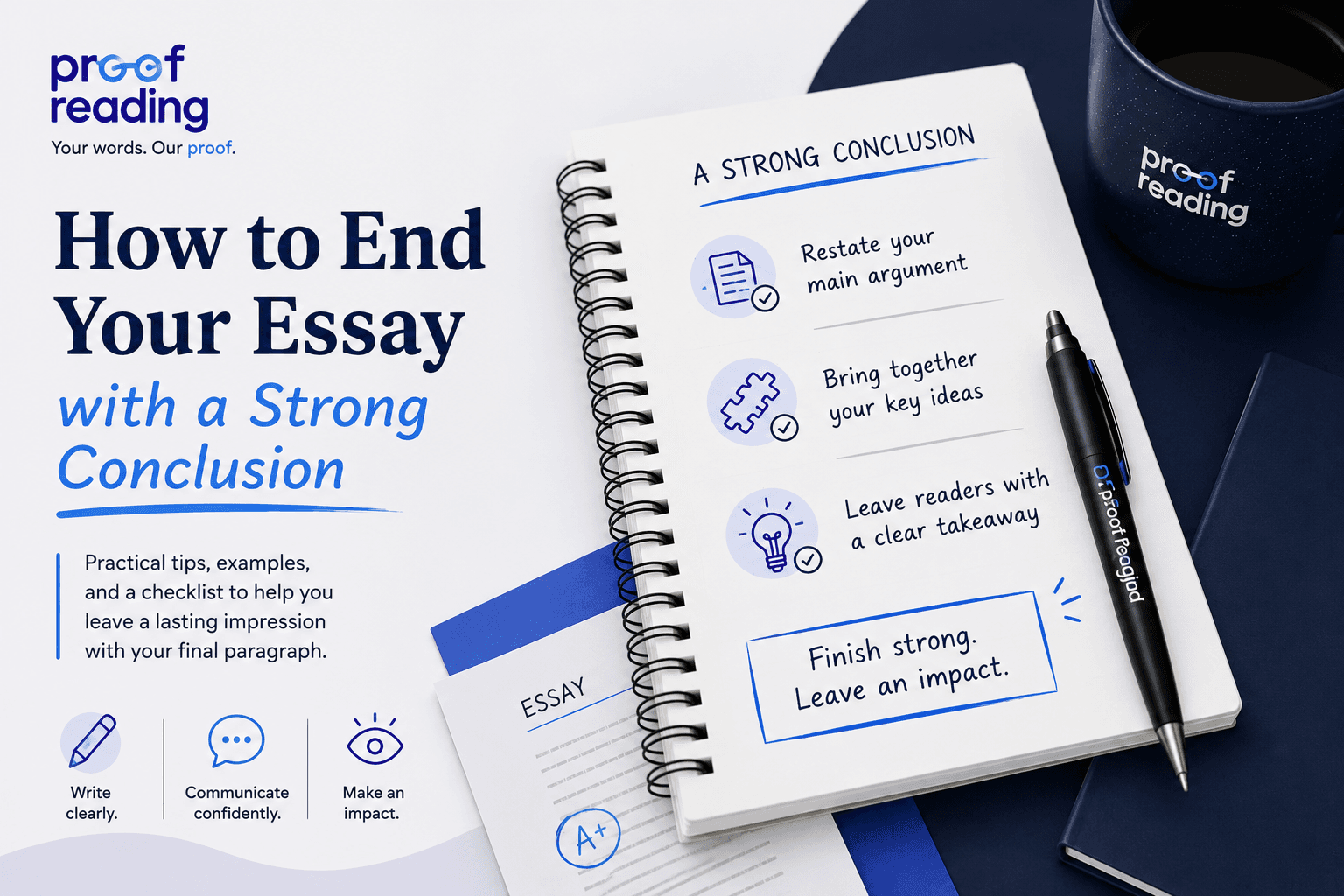
A strong conclusion has three clear responsibilities. It reminds readers of the essay’s central idea, brings together the main points without repeating them word for word, and finishes with a thought that gives the discussion a sense of closure.
Restate your main argument
↓
Bring together your key ideas
↓
Leave readers with a takeaway
Notice that none of these steps involves introducing new evidence. By the time readers reach the conclusion, they should already have everything they need to understand your argument. The conclusion simply helps them connect the ideas and leave the essay with a clear impression of its main message.
Weak vs. Strong Conclusion
Imagine your essay argues that regular reading improves academic performance.
Weak conclusion
In conclusion, reading is important. As this essay has shown, reading helps students in many ways. Therefore, everyone should read more.
There is nothing technically wrong with this paragraph, but it does very little. It repeats the main idea without adding perspective, and the final sentence feels predictable.
Strong conclusion
Reading regularly does more than improve grades. It strengthens vocabulary, develops critical thinking, and helps students engage more confidently with new ideas. Making time to read consistently is a simple habit that can support academic success long after the classroom experience ends.
The second version does not simply repeat the thesis. It brings together the essay’s main points and ends with a broader reflection. Readers finish with a clearer understanding of why the topic matters instead of feeling that the essay simply stopped.
When revising your own conclusion, ask yourself one question: Does this ending help readers understand the significance of my argument, or does it only repeat what they have already read? That small distinction often separates an average conclusion from a memorable one.
Common Mistakes Students Make
One of the most common mistakes is introducing a completely new argument in the final paragraph. If an idea is important enough to influence your conclusion, it probably deserved discussion earlier in the essay.
Another frequent problem is copying the thesis almost word for word. Readers do need to be reminded of your main argument, but they do not need to read the exact same sentence twice. Rephrasing the idea makes the conclusion feel more natural.
Some conclusions also end too abruptly. A single sentence followed by a period can leave readers feeling that the discussion was cut short rather than completed. Giving the essay one final reflective sentence creates a stronger sense of closure.
Finally, avoid overly broad statements such as “This topic will always be important” unless you explain why. Specific observations are usually more convincing than general claims.
Quick Checklist Before You Submit
Before submitting your essay, take one last look at your conclusion and ask yourself:
● Did I restate my main argument without copying my thesis word for word?
● Did I bring together the key ideas from the essay?
● Did I avoid introducing new evidence or arguments?
● Does my final sentence leave readers with a clear takeaway?
A strong conclusion does not need to be long or dramatic. Its purpose is simply to bring the essay to a satisfying close while reminding readers why the argument matters. Spending a few extra minutes revising your final paragraph can make the entire essay feel more complete, and often leaves a much stronger final impression.
Ready to Submit Your Essay?
A strong conclusion can leave a lasting impression, but it's only one part of a great essay.
Our professional editors can help you improve your essay's clarity, structure, grammar, and overall flow before you submit.