How to Write a Scholarship Essay That Actually Stands Out
How to Write a Scholarship Essay That Actually Stands Out
Scholarship committees review hundreds—sometimes thousands—of essays every cycle. After reading dozens of submissions with identical openings like, “I am applying for this scholarship because education is important to me,” evaluators quickly grow weary.
To win a scholarship, your essay needs to do more than list your achievements; it needs to make the reader remember who you are, what matters to you, and why your experiences have shaped your goals.
Here are some practical strategies to transform a generic essay into a memorable application, complete with before-and-after examples.
1. Hook the reader from the first line
The opening paragraph sets the tone. Avoid repeating the prompt or starting with a broad cliché about the value of education: “I have always wanted to become a doctor because I want to help people and make a difference in my community.”
There is nothing wrong with the idea, but it could belong to thousands of applicants.
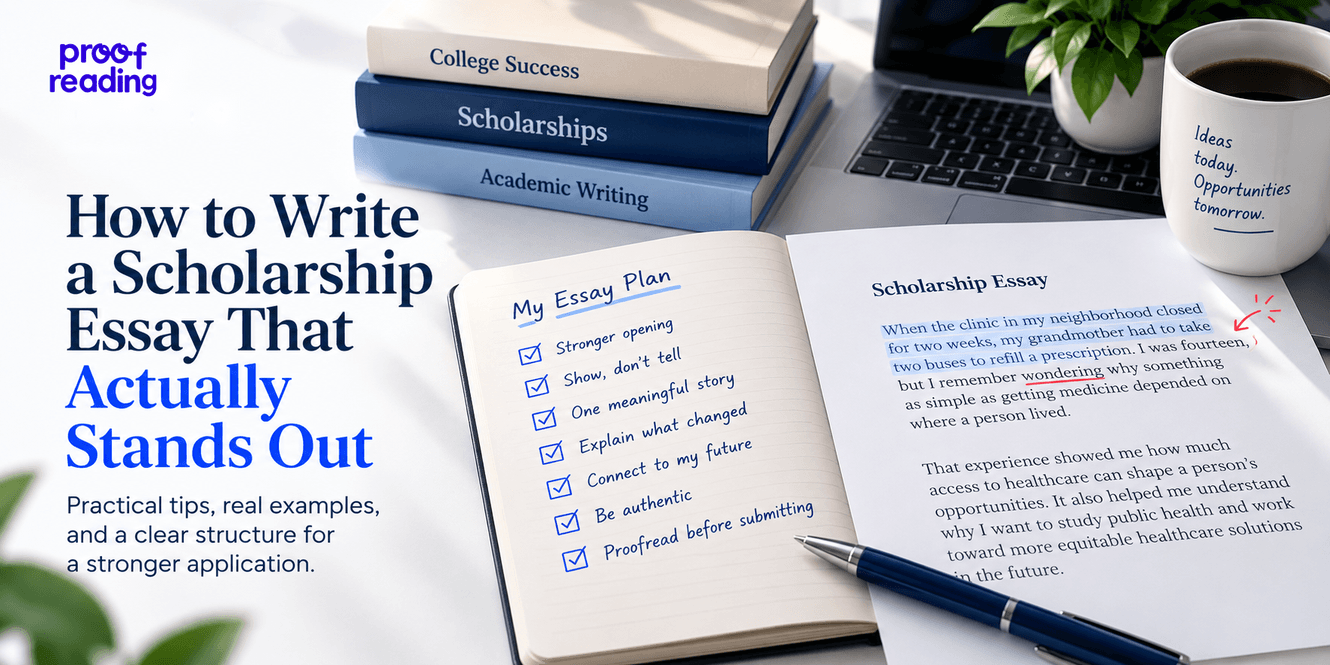
Instead, start in the middle of an action, a meaningful moment, or a compelling realization: “When the clinic in my neighborhood closed for two weeks, my grandmother had to take two buses to refill a prescription. I was fourteen, but I remember wondering why something as simple as getting medicine depended on where a person lived.”
The second version gives the reader something concrete to picture while introducing the applicant’s interest in healthcare access.
2. Show your qualities instead of listing them
Many applicants use vague buzzwords to describe themselves: hardworking, passionate, resilient. While these traits are positive, simply stating them isn’t persuasive. Show the selection committee how you embody these qualities through specific actions and details.
Before: “I am responsible, compassionate, and determined. I have demonstrated these qualities through my academic achievements and volunteer work.”
After: “During my final year of high school, I volunteered at an after-school program twice a week. When the younger students struggled with reading, I began bringing books from home and staying an extra thirty minutes to read with them.”
The reader can now see the student’s initiative and commitment rather than being asked to take those qualities on trust.
3. Choose one meaningful story
You do not need to describe everything you have accomplished. Trying to mention every award, activity, hardship, and future goal can make an essay feel like a résumé in paragraph form. Instead, choose one or two experiences that help explain something important about you.
For example, rather than writing: “I participated in the debate club, volunteered at an animal shelter, played basketball, and worked part-time while maintaining good grades.”
You might focus on one experience and explain its significance: “Working at the animal shelter taught me something that my classes had not: responsibility does not disappear when you are tired. Some Saturdays, after a full week of school and work, I still had to arrive at seven in the morning to clean kennels and care for animals that depended entirely on us.”
The second version gives the activities meaning instead of simply listing them.
4. Explain what changed
A compelling story usually has some kind of development. Ask yourself: What did I think before this experience, and what do I understand now?
For example: “Before volunteering at the community library, I thought libraries were mainly places where people borrowed books. After helping children with their homework and assisting older residents with online forms, I began to see the library as something larger: a place where people could access information, technology, and support.”
This reflection is what turns an anecdote into an essay.
5. Connect your experience to your future
Your conclusion should not simply repeat your introduction or say that you hope to receive the scholarship.
Instead, connect the experience you described to what you plan to do next.
Before: “Receiving this scholarship would help me achieve my dream of becoming an engineer and making my family proud.”
After: “I cannot know exactly where my engineering career will take me, but I know what I want to carry with me: the belief that technical solutions should respond to real human needs. Studying engineering will give me the knowledge to turn that belief into practical work.”
This makes the scholarship part of a larger story rather than the essay’s sole purpose.
6. Let your natural voice come through
A scholarship essay should be polished, but it should still sound like you. Avoid filling every sentence with sophisticated vocabulary simply to sound academic. Clear, precise writing is usually more effective than language that feels borrowed from a thesaurus.
Before submitting, ask yourself:
· Does this essay contain specific experiences rather than general claims?
· Can the reader understand what I learned?
· Have I explained why these experiences matter?
· Does the essay sound like something I would actually say?
· Have I answered the scholarship’s prompt directly?
A memorable scholarship essay does not require a dramatic life story. What matters is the way you tell your story: specific details, honest reflection, and a clear connection between your experiences and your goals.
Ready to submit your scholarship essay?
Before you send it, give your essay a final review for grammar, clarity, consistency, and errors.