The Most Confusing English Homophones (and How to Never Mix Them Up Again)
The Most Confusing English Homophones (and How to Never Mix Them Up Again)
If English homophones keep tripping you up, you are not alone. They can be especially tricky for ESL learners because your ears say, “Same word!” while the grammar says, “Absolutely not.”
Here are some of the most commonly confused pairs, plus simple memory tricks.
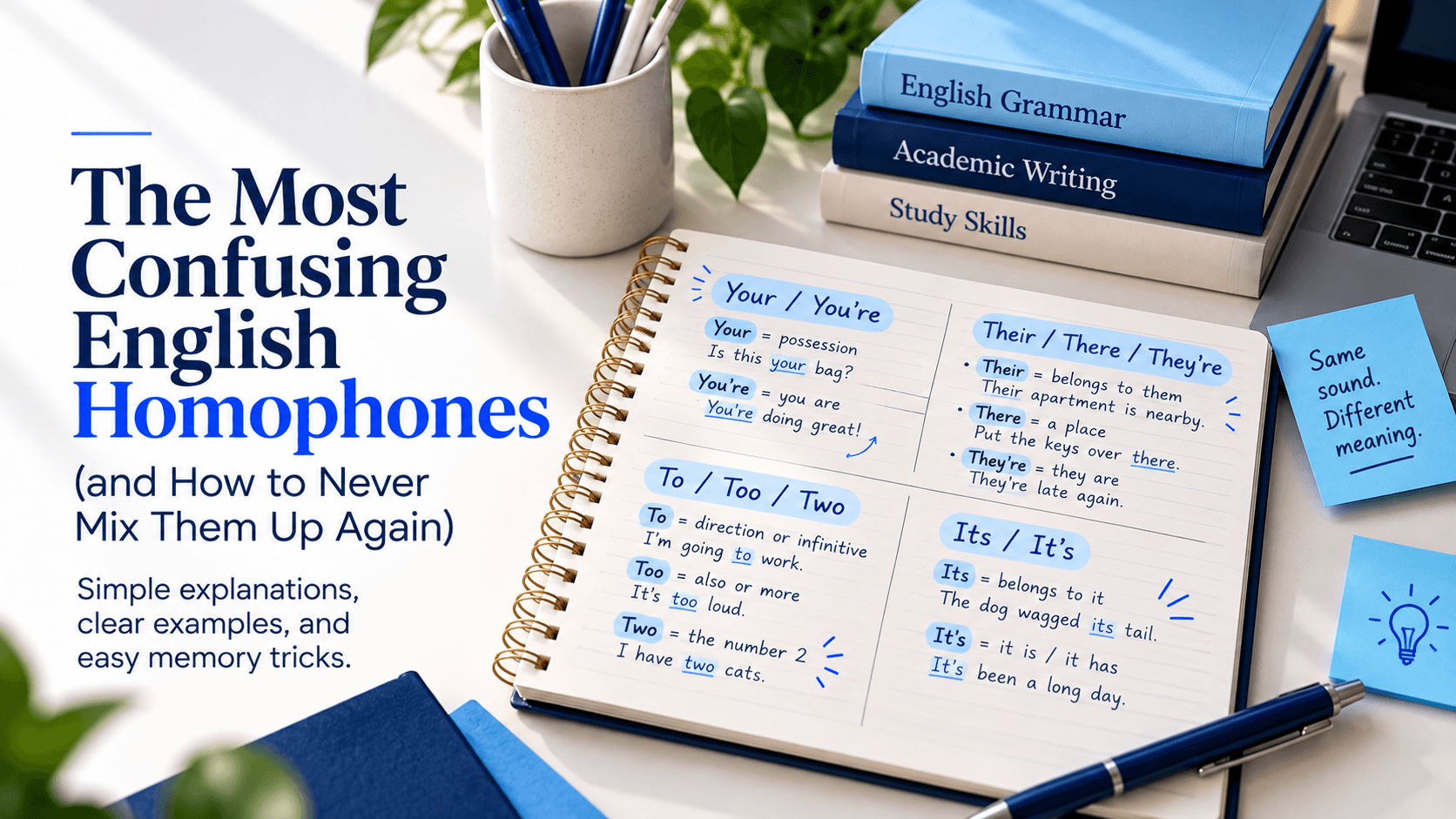
1. Your/You’re
· Your shows possession: “Is this your bag?”
· You’re means “you are”: “You’re doing great.”
Quick check: replace it with “you are.” If the sentence still works, use you’re.
“You’re welcome” = “You are welcome.”
“Your welcome” is incorrect.
2. Their/There/They’re
These three sound identical, but each has a distinct job.
· Their means “belongs to them”: “Their apartment is nearby.”
· There refers to a place: “Put the keys over there.”
· They’re means “they are”: “They’re late again.”
Memory trick: here is inside there—both relate to places.
3. To/Too/Two
· To is used for direction or an infinitive verb: “I’m going to work.” / “I want to learn.”
· Too means “also” or “more than necessary”: “Me too!” / “It’s too loud.”
· Two is the number 2: “I have two cats.”
A useful habit: if you could say “also,” choose too.
4. Its/It’s
· Its means “belongs to it”: “The dog wagged its tail.”
· It’s means “it is” or “it has”: “It’s raining.” / “It’s been a long day.”
This pair feels unfair because apostrophes usually show possession in English. But possessive pronouns—his, hers, ours, theirs, its—do not use apostrophes.
5. Then/Than
· Then is about time or what happens next: “First eat, then leave.”
· Than is for comparisons: “This test is easier than the last one.”
Memory trick: “than” has an “a,” like “comparison” has an “a.”
6. Hear/Here
· Hear is connected to sound: “Can you hear me?”
· Here means in this place: “Come here, please.”
Think of ear inside hear. You hear with your ears.
7. Weather/Whether
· Weather means rain, sun, wind, and temperature: “The weather is beautiful.”
· Whether introduces a choice or uncertainty: “I don’t know whether to go.”
Memory trick: weather has eat in it—perhaps because weather can affect what you want to eat.
8. Compliment/Complement
· A compliment is praise: “She gave me a nice compliment.”
· A complement completes or improves something: “That sauce complements the pasta.”
Remember: a compliment makes you smile. The word has an “i,” like “I feel good.”
Easy Memory Tricks
· Link the word to its meaning, not just its sound.
· Check the grammar role: possession, contraction, number, or direction.
· Read the whole sentence out loud and ask, “Which meaning fits?”
· If a word can be expanded, test it: you’re = you are, they’re = they are, it’s = it is.
Want to make fewer mistakes in your writing?
Clear, correct English matters when you're writing papers, applications, and other important documents.