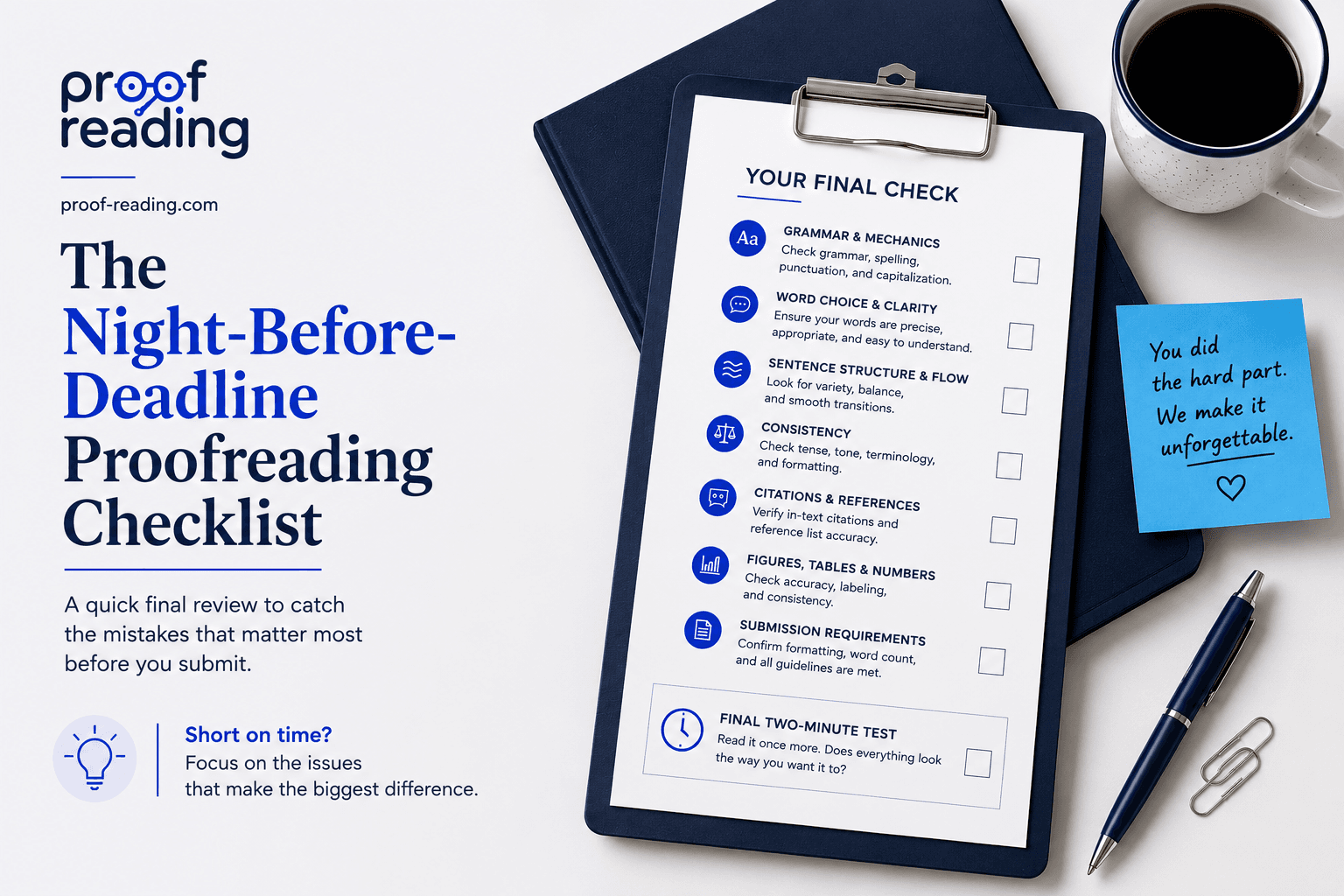
The Night-Before-Deadline Proofreading Checklist
The Night-Before-Deadline Proofreading Checklist
Short on time? Don’t try to perfect every sentence. Focus on the mistakes most likely to affect clarity, accuracy, credibility, and compliance with requirements.
1. The “Big Picture” Scan
☐ Read the prompt, assignment guidelines, or brief again. Does the paper address exactly what was asked?
☐ Is the paper’s purpose, research question, thesis, or central argument clear?
☐ Does the introduction establish the necessary context and tell the reader what to expect?
☐ Does each section contribute to the paper’s purpose or argument?
☐ Does the conclusion draw together the main findings or argument and explain their significance?
☐ Remove anything irrelevant.
2. Structure and Flow
☐ Give each paragraph one main purpose or idea.
☐ Ensure topic sentences clearly establish the point of each paragraph.
☐ Check that ideas appear in a logical order.
☐ Make sure relationships between ideas are clear; add transitions where needed.
☐ Move sentences or paragraphs if an idea appears before the information needed to understand it.
☐ Break up paragraphs that are difficult to navigate or too long.
☐ Check that headings accurately reflect the content that follows them.
3. Hunt for High-Impact Sentence Problems
☐ Read the paper aloud, or use text-to-speech.
☐ Fix sentences that are difficult to understand, ambiguous, incomplete, or grammatically overloaded.
☐ Replace vague references such as “this shows,” “this,” or “it” when the intended meaning is unclear.
☐ Cut unnecessary filler such as “in order to,” “very,” “really,” or “it is important to note that” when it adds nothing.
☐ Prefer precise, direct verbs when they make the sentence clearer.
☐ Check that modifiers clearly refer to the words they modify.
☐ Check that lists and comparisons use parallel grammatical structures.
4. Run a Fast Grammar and Mechanics Sweep
☐ Check subject–verb agreement.
☐ Check verb tense consistency.
☐ Look for sentence fragments and run-on sentences.
☐ Check pronoun references: Is it always clear who or what “they,” “this,” or “it” refers to?
☐ Check articles, prepositions, and common grammatical errors.
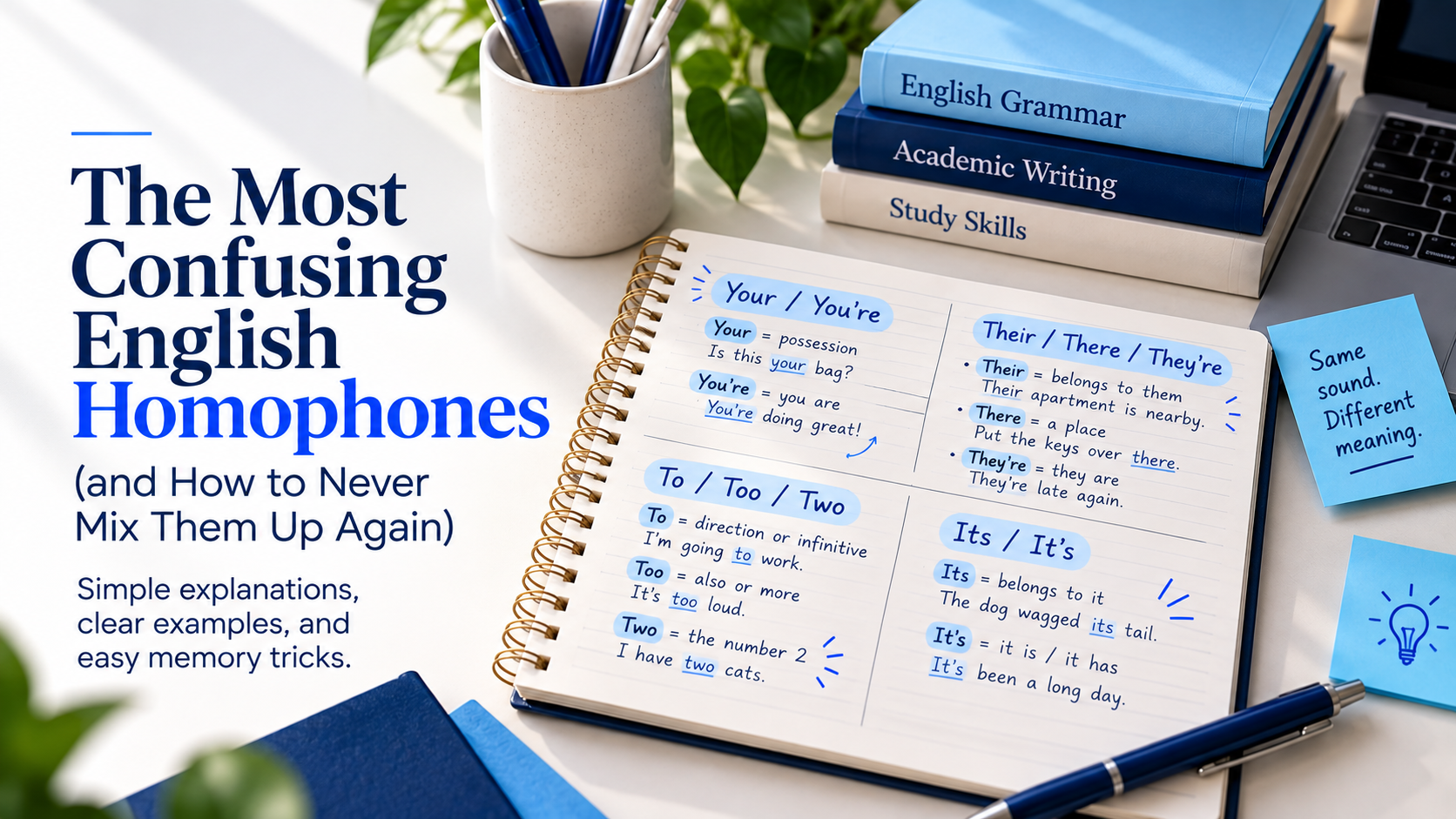
☐ Watch for commonly confused words: “their/there/they’re,” “your/you’re,” “its/it’s,” “affect/effect.”
☐ Check punctuation, especially commas, apostrophes, quotation marks, colons, and semicolons.
☐ Check spelling, including names, technical terms, and proper nouns.
5. Verify Evidence, Facts, and Citations
☐ Make sure factual claims, statistics, data, quotations, and paraphrased ideas are appropriately supported.
☐ Make sure every quotation has the required citation.
☐ Check that in-text citations match the reference list or bibliography.
☐ Verify authors’ names, publication dates, titles, page numbers, URLs/DOIs, and other required bibliographic information.
☐ Confirm that quotations accurately reproduce the original source.
☐ Make sure quotations and paraphrases are introduced and integrated into your argument rather than dropped into a paragraph.
☐ Check that the evidence actually supports the claim being made.
☐ Delete sources listed in the bibliography but never used.
☐ Check that your citations follow the required style consistently.
6. Consistency
☐ Use key terms consistently throughout the paper.
☐ Check capitalization of headings, proper nouns, and specialized terms.
☐ Check abbreviations: define them at first use and use them consistently afterward.
☐ Check consistency in dates, numbers, units, names, and terminology.
☐ Check spelling conventions such as US vs. UK English.
☐ Make sure headings, lists, tables, figures, and captions follow a consistent format.
7. Presentation and Submission Requirements
☐ Check the required word count or page limit.
☐ Confirm font, spacing, margins, headings, and page numbers.
☐ Check the title: is it specific and relevant?
☐ Check that tables, figures, appendices, and other elements are numbered and referenced correctly, if applicable.
☐ Confirm that the required citation and reference-list format has been followed.
☐ Run spellcheck, but review every suggested change.
☐ Save a final copy with a clear filename.
☐ Confirm that you are submitting the correct file and file format.
The Final Two-Minute Test
Before submitting, ask:
☐ Is the paper’s purpose or main argument clear?
☐ Does every section contribute to that purpose?
☐ Are important claims supported by appropriate evidence?
☐ Are citations and references complete and consistent?
☐ Would a tired reader understand the paper correctly on the first read?
☐ Have I checked the requirements and the writing?
☐ Am I uploading the correct final file?
Proofread for clarity first, correctness second, and polish last.
Want to keep this checklist?
Download the Night-Before-Deadline Proofreading Checklist
Save it, print it, and use it for your final review before submitting your paper.
Still worried you missed something?
When the deadline is close, a second pair of eyes can make a difference.